ACES Regulations 2006
1 - General regulations
1.1 About ACES
Air Combat Elementary Support (ACES) is an international contact-network for
R/C-pilots interested in R/C Air Combat. The organization is democratic and
non-profit. Elections are made through voting, by concerned members.
1.1.1 Membership
Every person that is interested in R/C Air Combat may become a member of ACES.
A member may be suspended if he abuses the ACES regulations, after several
warnings from the ACES administrators. To become a member of ACES, contact
your national contact.
1.1.2 Economy
Every
country within ACES covers its own expenses. This includes all administration
posts as IC, NC etc.
1.1.3 Language
The
official language in ACES is English.
1.1.4 Copyright
The copyright of the
ACES-regulations and of the R/C Air Combat rules belong to all members of
ACES.
1.2 ACES network
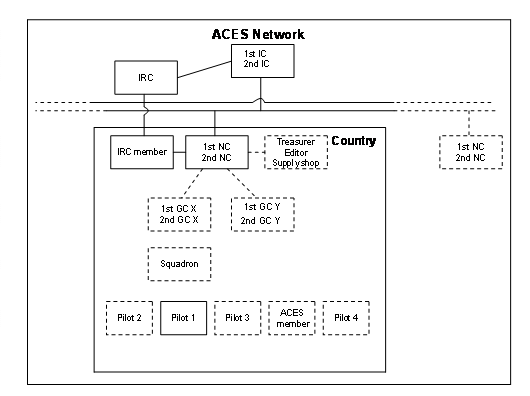
The ACES network is
built up by several contacts. Contacts operate at different levels according
to the following figure (Dotted boxes are optional).
1.2.1. ACES country
All
countries connected with national contacts (NCs) in ACES network, are
countries of ACES organization.
1.2.2. ACES pilot
ACES
pilot must be member of ACES country. Pilot counts, as having flown at least
one sortie and the result is stored in Co_Re database. She, he may participate
in vote and elections and may be included in calculations for IRC member
electoral power.
1.2.3. International Coordinator
The 1st
International Coordinator (1st IC) should coordinate ACES across
the different countries. He should keep contact between countries, distribute
international rules, and arrange international voting. He should also decide
in conflicts concerning interpretation of international rules and regulations.
The IC appoints also new NCs in new nations within ACES.
1.2.4. National Contact
The National
Contact (NC) should co-ordinate ACES in his own country. He should
distribute rules to the national members, arrange national voting and see to
that the national ACES works smoothly. He should also decide in conflicts
concerning interpretation of national rules and regulations. The NC is
responsible for the national Air Combat Cup. The NC appoints his assistant,
the 2nd NC and IRC member. He also appoints the national
treasurer (if any), the national newsletter-editor (if any), and
the person responsible for the national supply shop (if any). He also
appoints GCs in new groups.
1.2.5. Group Contact
If ACES within a
country becomes big, the National Contact can decide to divide it into two or
more Groups. The Group Contact (GC) should co-ordinate ACES in his group (if
any). The GC is responsible for the national Air Combat Cup in his part of the
country. The GC appoints his assistant, the 2nd GC.
1.2.6. Squadron
A group of four or
more members of ACES may form a Squadron (Sqn). The Squadron has no
organizational role.
1.2.7. International
Rule Committee (IRC)
IRC is a team of
representatives of ACES countries. Every NC appoints one representative (NC or
another person) for IRC. IRC accepts or deny international rules and
regulations change proposals. Electoral power of IRC members is relative -
each IRC member can have between one to five votes. The number of votes
depends on number of country’s pilots by formula: electoral power of IRC
member = 1 vote + 1 additional vote for every 10 pilots, but maximum 5 votes.
Electoral power of IRC members is calculated every year.
1.3
Rules, voting and elections
Air Combat rules are
decided and distributed by ACES. Rules change according to voting.
1.3.1 Proposals for rule change
Every member can
propose for rule change. A proposal is not considered, unless it has three
named supporters that are all members of ACES. A proposal is made to the NC
and to the national vote. A proposal should be written in English, and be
ready to be distributed to the other countries within ACES.
1.3.2.1.
International elections for 1st IC
The 1st IC
(First International Coordinator) is elected every second year by all pilots
of ACES. At the request of any ACES nation, an annual voting on the 1st
IC may be performed. The NCs sends candidate-names for the post as 1st
IC to the 1st IC. In the international vote the 1st IC
then sends out candidate names for the post as 1st IC, to all of
the NCs
1.3.2.2.
International elections for 2nd IC
The 2nd IC
(Second International Coordinator) is elected every second year by all pilots
of ACES, but not in the same year than the 1st IC, to provide
continuity. The NCs sends candidate-names for the post as 2nd IC to
the 1st IC. In the international vote the 1st IC then
sends out candidate names for the post as 2nd IC, to all of the NCs
1.3.2.3.
International vote for rules and regulations change
Every second year an
international vote is made. The IRC receives international proposals for
change of rules and regulations from 1st IC. Then IRC members must
decide which proposals are acceptable. They are responsible for transparency
and consistency of new set of rules and regulations as a whole. The decisions
are the result of discussions and elections between IRC members. When
finished, IRC sends the results of decisions to the 1st IC. In case
of serious disagreements, where decisions between IRC members are not
possible, 1st IC may arrange general elections between all ACES
pilots.
1.3.2.4. National
elections for 1st NC
The 1st NC
(First National Contact) is elected every year by all pilots of ACES in the
particular country.
1.3.2.5. National
elections for 1st GCs
The 1st GC
(First Group Contact) is elected every year by all pilots of ACES in the
particular region.
1.3.2.6. National
vote for rules and regulations change
The year before the
international vote, a national vote is held. The national vote is held every
second year, in years where no international vote is held. The NC sends
proposals, which get majority in the national vote to the 1st IC.
1.3.2.7. Extra vote and elections
The IC may call for
an extra vote if the IC finds it necessary due to special situations. In case
an elected candidate does not fulfill his duties, the higher administrator
within ACES may call for a new election to the post. The higher administrator
may also appoint a new administrator to take care of the post until the
election can be made.
1.3.3 Count of votes
Every
given vote counts as one vote in the international vote. If a tie should
occur, the result is judged as not in favor of the proposal.
1.3.4 Distribution of rules
After
the annual vote, the IC writes a new English set of rules, and distributes it
to the NCs. The new set of rules is not used until one year after it was
written. This means a vote held in year X, has an impact on rules of year X+2.
The new regulations are used the next year however, meaning it is used in year
X+1 according to the example above. The NC may either translate the new rules
into his national language, or keep the rules in English. He should distribute
the new rules to the national members.
1.3.5 International and national rules
Every country has a
veto on rules, in such way that they may change their national rules according
to national voting for rules change. Rules may also vary across different
nations due to safety-concerns. At international competitions, the
international rules are used.
1.4
Air Combat Cup
Competitions within
any region, each year, may be gathered in a cup. Competitions within the cup
must have been announced to the members of ACES within the region at least one
month before the competition is due.
1.4.1 Scoring in a cup
The total cup-score
of a pilot is counted as the sum of the X best rounds flown by the pilot, in
the contests that are part of the cup. The number X is decided on per
cup-basis.
1.4.2 Competition
As competition
counts any organized competition held according to the national or
international Air Combat rules, with at least two competitors. The competition
must also have been sanctioned by the National Contact.
1.4.3 Championships
As a national
championship counts one single contest held at most once a year in a country.
As an international championship counts a contest that covers several
countries at most once a year in a specified area, and this contest must have
contestants from at least two of the different countries.
1.4.4 Competition points
The total score of
the competitor counts as his result from the competition.
1.5. Eurocup
Every ACES country
may arrange one Eurocup contest within national cup per year. Country with
more than nine (9) contests per year, may arrange one additional Eurocup
contest. The total cup score of a pilot in Eurocup is counted as the sum of
the six best rounds – but not more than three rounds in the same country.
1.6. WASG
One contest per year is declared as World Aircombat Scale Games. This contest
is not part of any other contest system. Arranging group defines the number of
rounds but it must be more than three. The winner of WASG contest is nominated
as World Aircombat Champion of the year.
2.1
About optional regulations
These rules are
optional, which means that any one member of ACES may or may not wish to use
all or part of these regulations. Within these rules are some military
insignias, such as ranks, order ribbons etc. Remember that these insignias are
just a decoration, and by no means gives the bearer the right to command any
other member of ACES.
2.1.1 National Supply shop
The decorations and
awards mentioned here can be sold by the national ACES supply shop. Different
countries may have different decorations, and may choose not to use some of
the decorations.
2.2 General definitions
2.2.1 Sortie
Having flown a sortie
counts as having received at least one whole (1.0) flight-time point in a
competition flight.
2.2.2 Kill
A kill is
defined as the result when two or more A/C collides during a fight. If all of
the A/C involved in a collision crash then all pilots involved in the
collision gets half a (0,5) kill. If one or more A/C involved in a collision
crash, and one or more A/C are able to continue to fly, then the pilot(s) who
continue to fly gets a
(1) kill. In this
case, the pilot(s) that crash gets no kill. “Continue to fly“ is defined as
being airborne at least the 15 seconds immediately following the collision.
2.2.3 Administrator
An administrator
is a person who is either an International Coordinator, a 2nd
International Coordinator, a National Contact, a 2nd National Contact, a Group
Contact, a 2nd Group Contact, a treasurer, a newsletter-editor, IRC member,
Co_Re administrator or responsible for the national supply shop.
2.3 Special decorations
2.3.1 Fighter wing
You
may wear the fighter wing as soon as you have made a sortie during a
competition.
2.3.2 Badges
Within ACES, there
are different badges for the different levels within the organization. The
following badges might exist: ACES, National ACES, Group and Squadron. In
addition one may use national flag badges to show which country one belongs
to, and in which countries one has competed. Badges can also be made to show
which orders one has received, for instance an ACE-badge, etc.
2.3.3 Medals
Three
medals exist, based on how many sorties the pilot has flown: Bronze Star (50
sorties), Silver Star (100 sorties) and Gold Star (200 sorties). In addition
medals can be used as an award to a national champion, a cup-winner etc.
2.4
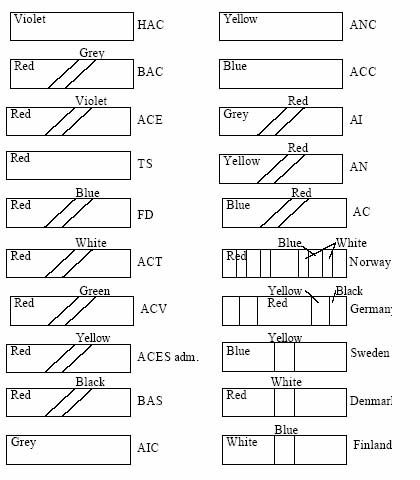
Order ribbons
The size of the order
ribbons are 10x35mm. They should be placed at a maximum of four in a row, and
in the order stated below.
2.4.1 Honored Air Combatant (HAC)
One member that has
done extra valuable duties for ACES, are elected by all the members of ACES
every year, to receive this order.
2.4.2 Best Air Combatant (BAC)
The pilot that wins
the national cup, every year in each country, is awarded as “Best Air
Combatant of <nation> <year>“.
2.4.3 Air Combat Expert (ACE)
A
pilot who has gathered five or more kills is awarded as ACE.
2.4.4 Top Shot (TS)
The award “Top shot“
is given to any pilot who has achieved at least an average of 1.25 cuts per
fight in a single contest. The average is counted across every possible number
of fights, including the finals, even though the pilot may not have qualified
to the finals.
2.4.5 Fighter Designer (FD)
To receive Fighter
Designer, a member must design a fighter according to R/C Air Combat rules,
and send a full-size plan of the design to the National Contact for
evaluation. The fighter must also have flown at least one sortie, and the
design must not be a copy of another design.
2.4.6 Air Combat Test pilot (ACT)
A
pilot who has flown at least a sortie each with at least ten
different types of A/C, receives the award Air Combat Test pilot.
An A/C-type is defined as “Spitfire“, “FW190“, etc. Subtypes,
like “FW190A“ and ”FW190D-9“, do not count.
A pilot who has flown at least 50 sorties, receives the award Air
Combat Veteran.
2.4.8 ACES Administrator
An administrator that
has worked for ACES for at least one whole year, receives this order.
2.4.9 Best Aircombat Squadron (BAS)
This
award is given to the squadron in every country, that has gathered most points
in sanctioned events during the year, in contests across the world. A pilot
must fight for the same squadron the whole year, and a list of the squadron
members must be supplied to the NC at the beginning of every season. The award
is given as: Best squadron of <nation> <year>.
2.4.10 Aircombat International Champion (AIC)
A pilot who has won
an international championship, receives this award.
2.4.11 Aircombat National
Champion (ANC)
A pilot who has won a
national championship, receives this award.
2.4.12 Aircombat Competition
Champion (ACC)
A pilot who has won
an aircombat competition, receives this award.
2.4.13 Aircombat International championship (AI)
Is given to a member
who has competed in an aircombat international championship.
2.4.14 Aircombat National championship (AW)
Is given to a member
who has competed in an aircombat national championship.
2.4.15 Aircombat Competition (AC)
Is given to a member
who has competed in an aircombat competition.
2.4.16 Nations
Are given to a member
according to which countries he has competed in.
2.5
Ranks
A member of ACES
receives ranks according to the following rules.
2.5.1 Rank regulations
A new
member of ACES has no rank (Pt.=Private). After having competed in a
competition or after becoming an administrator, the member receives the rank
of Corporal (Cpl.). After that, the member is promoted as soon as he has flown
25 sorties. After another 25 sorties, he is promoted again. From there on, he
is promoted for every 50 sorties he flies. An administrator is in addition
promoted for every whole year he has worked as an administrator.
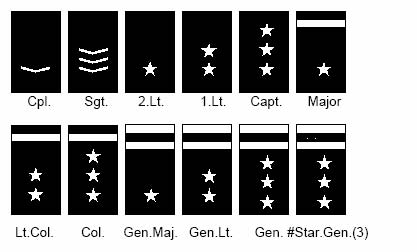
2.5.2 Rank patches
The rank patches
should look like the following figures. Note: In the “# Star General“, the #
can be replaced by any number of stars from 1 and upwards. A “1 Star General“
is of course the lowest (but above an ordinary General).
2.6
Placement of decorations
The following
recommendations apply on where to put the different decorations.
2.6.1 The fighterwing
The
fighterwing should be placed at the left side of your flight-suit. The
fighterwing may also be placed at the front of your cap.
2.6.2 The order-ribbons
The order ribbons
should be placed at the left side of your flight-suit, beneath the fighterwing
(if any).
2.6.3 Rank Patches
Rank patches should
be placed on the shoulders of your flight-suit. They may also be placed at the
front of your cap.
2.6.4 Medals
Medals should be placed at the right side of your flight-suit.
2.6.5 Badges
Badges may be placed
anywhere at your flight-suit or at your cap. The normal placement though, is
at the arms of your flight -suit, with the highest-level badges at the
highest.