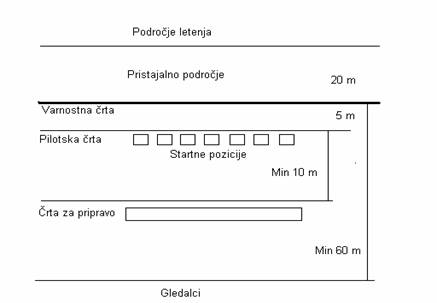
2.2 Flight area
The flight area is always in front of the safety line. The safety line
is parallel to the pilots line, situated 5m in front of the pilots line.
During all day of the contest, all A/C must fly in front of the safety
line (as soon as the safety line is drawn up). Note that safety line
penalties are given all day, if A/C crosses the safety line
(including test-flights before, in-between and after fights). Any
model that ends up in front of the landing zone may not be
fetched during the fight, or while other models are airborne.
2.3 Start pits and readiness area
The start pits are placed with three meters in-between. The
readiness area is placed behind a line approximately 10 meters
behind the start pits. At readiness, pilots and helpers must be
behind this line.
2.4 Audience
The audience should be kept at a safe distance (at least 60m)
behind the safety line, or be protected by protective devices,
such as nets, etc. The area protected by safety nets is defined as
an area starting from the point where the net ends, and to a
distance equal to the net height. This means that for a 3m
vertical net, the safe area is measured from behind the net and 3
meters back. In addition, the first meter behind the net should be
considered as unsafe. All other areas within 60 meters from the
safety line should be fenced off, for people not wearing hardhats.
2.5 First Aid
On the contest site, a spot should be marked up as the first aid
spot. At this spot, basic first aid equipment should be available
for instant use, in case of an accident.
3 Equipment
3.1 The model
The model must be a scale or semi scale A/C of a warbird built
between 1935 and 1945. The original A/C engine must have a
take off power of at least 500hp . The scale is 1:12 and the wing
span and fuselage length may not deviate more than +/-5% from
scale. All other measures may not deviate more than 2cm from
scale. The fuselage length is measured in-between the leading
edge and the rear edge of the fuselage, or the backside of the
propeller(s), if any. The wing thickness must be 10% or more,
measured at the thickest point of the chord. No protruding
devices may exist on the front leading edge of the wing, stabilizer
and fin. The A/C must look similar to the original A/C, including
painting and decorations. The competitor should bring a
published 3-plane view of the original A/C-type, in at least 1:72
scale, to the competition to show that his A/C is accurate
according to measures. The contestant does not have to be the
builder of the model. If the original A/C had fixed undercarriage
or flotation devices, the model A/C must have these also.
3.2 Engine
Mufflers made by other manufacturers may be used. Extension
parts may be used to get the muffler outside of the fuselage. The
contestant must be able to shut-off the engine in the air,
whatever the attitude of the A/C. Engines that are used in
ducted-fans, may use tuned-pipes, others may not.
3.3 Engine size
If the original A/C had a span of at least 12 meters and the model
has a span of at least 1 meter, the model may use a .21 2- stroke
engine or a .21-.26 4-stroke engine. If the original A/C had a
span of at least 12 meters with a wing area of at least 25 m², and
the model has a span of at least 1 meter, the model may also
use a .25 2 -stroke engine. Other models may use a.15 engine.
They may use a .21 - .26 4-stroke engine as well.
Multi-engined A/C may use .15 engines, and the model must
have the same number of engines as the original A/C.
Single engined ducted fan models may use a .25 engine.
Electrical engines may be used without limitations , but in
accordance to 3.4 .
3.4 Engine performance and propeller
The following table applies for maximum engine performance
and propeller used. The maximum propeller to be used is found
by adding the propeller diameter and pitch (inches).
Engine size RPM max Sum of Prop. max (inches)
- .15 17.000 12
- .21 16.000 14
- .25 16.000 14
- electro 16.000 13
-.26 4-stroke 13.000 15
Revolution measurement is executed in certain cases, based on
the main judges and/or organizers decision. Revolution
measurement, if any, has to take place before the heat during
readiness.
The RPM is measured at full throttle, and with the needle setting
used in contest. The measuring party should have full access to
both the engine/model and the controlling transmitter. It is the
contestant’s responsibility to ensure that the engine is within the
limits using the RPM meter(s) used by the arranging group. Only
propellers that are commercially available in the country the
contest is held may be used. As commercially available means
the propeller can be bought in normal hobby-shops. All propellers
used on the model aircraft must be of a safe design for its proposed use.
(The use of electric or slow fly propellers with an internal combustion engine is prohibited.)
3.5 Model weight
The following table applies on model weights:
Engine (min.) Model weight
.10 500g
.15 700g
.21 1000g
.25 1000g
-.26 4-stroke 1000g
Electrical engine 700g
Single ducted fan 700g
Multi-engined 1200g
Max. weight for any model is 1700g.
3.6 Streamer
The streamer is 12 +/- 0,5 meters long one piece. It shall be 10-
15mm wide. Material shall be suitable for proper indication of
cuts, e.g. withstand moisture.
The streamer is marked on both ends for about 0,5 meters
respectively.
3.7 Helmet
A helmet must be used by any person that is in front of the
audience line. The helmet should cover the upper part of the
head and put up with a direct hit of an A/C.
3.8 Radio equipment
Every contestants radio equipment should be range checked
before the contest. The contestant is responsible for proper
operation of the radio equipment.
4 The contest
4.1 Structure
Each fight consists of at least two and at most seven pilots that
fly against each other. When all pilots have flown exactly one
fight, this is called a round. The next round, flight-lists are
changed to make it possible for as many pilots as possible to
meet each other in different fights. The number of rounds flown
at a contest is decided by the arranging group, and must be told
in the contest-invitation. The number of rounds is recommended
to be 3. A contest also has a final which is flown after the rounds
In the final, the seven pilots with the highest scores meet. The
pilot who has most points after the final wins the contest.
4.2 Fights
A fight is divided into three parts: The preparation, readiness and
flight part.
4.2.1 The preparation part
The length of the preparation part may be set by the arranging
group, but is recommended to be 7 minutes at smaller contests.
It is marked by the main judge blowing three signals in his whistle
and calling out ”Seven minutes to readiness”. During the
preparation-part test flights may be performed. 30 seconds
before the preparation-part ends the main judge blows two
signals in his whistle and calls out ”30 seconds to readiness”.
4.2.2 The readiness part
Readiness follows immediately after the preparation part, and is
marked by the main judge calling out ”Readiness”. During
readiness all pilots and helpers shall be behind the readiness
line. Exceptions will be made in the case of revolution
measurements (resp.3.4) All equipment must remain in the start
pits, and engines may not be running. Readiness may vary in
length, upon the main judges decision.
4.2.3 The flight part
The flight part starts when the main judge blows one long signal
in his whistle. Pilots and helpers may now run to their A/C, and
get them airborne. The flight-part ends when the main judge
blows one long signal in his whistle. The pilots may now fly freely
in front of the safety line, and land at their own discretion. As
soon as all A/C has landed, the next preparation part may start.
4.3 Helpers
Every contestant may have a helper. Only one helper is allowed
to stick with the pilots line during the fight.
4.4 Take off
Take offs are only allowed in the area between the pilot line and
the safety line.
4.5 Flight time points
One point per three seconds airborne, is given. Maximum flighttime
is seven minutes.
4.6 Restarts
An unlimited number of restarts are allowed during a fight. When
a pilot attempts to fetch his plane from the landing zone during a
heat he must get a permission from the main judge. The main
judge then gives an alarm and ensures that all the pilots are
aware of the situation. A restart must be made from the same
place the first start was made. Restarts are only allowed if the
model ends up in the landing zone, after landing. Restarts shall
be conducted solely between the start pit allocated to the
individual pilot and the safety line.
4.7 Change of A/C
The same A/C must be used throughout one fight. A new A/C
may be used the next fight. The model is defined as main parts
of fuselage and wing.
4.8 Crossing of lines
A crossing is made either the A/C is airborne or is moving on the
ground. When airborne the A/C must be clearly over the line. On
the ground, the engine counts. If a model has several engines,
any engine crossing the line counts.
4.9 Safety line crossing
The first time a pilot crosses the safety line with a model during a
contest, the pilot receives a minus point penalty. The second time a
pilot crosses the safety line with a model, the pilot is immediately
disqualified from the contest, and ordered to land immediately if airborne.
Disqualfied pilot loses all points and number
of sorties gained on the current contest.
4.10 Lost streamer
It is the contestants responsibility to get airborne with a streamer
of appropriate and full stretched length attached to his A/C. After
landing, missing or entangled streamer counts as lost (no +50p
given), except if the streamer was lost during landing, which must
be proved by finding the missing streamer. To gain the intact
streamer bonus, the model and streamer must have been
airborne during the fight at least 10 seconds.
4.11 Streamer cut
A contestant that cuts streamer off an enemy A/C in the air, gains
+100p. If having an enemy streamer stuck to the model, the
following rules apply:
A cut made to a stuck streamer, counts as a cut on enemy
streamer, and the contestant making the cut gains +100p. If
having a stuck streamer cut by an opponent, the contestant does
not lose his streamer-points. Only cuts made to the streamer
actually attached to the contestant’s model count. If during one
flyby cuts are made to several streamers (own and stuck) or
several cuts are made to the same streamer, this only counts as
one cut made to enemy streamer.
If a cut comes along with a collision more or less at the same
time (during one fly by), only the cut counts.
4.12 Collision
If two or more A/C have been apparently involved into a midair
collision, a clear proceeding is applied:
The contestant, whose A/C remains flying after a midair collision
may decide to continue flying to gain further flight points.
No kill points nor consolation points will be given. Flight time shall
be stopped when the fuselage of the A/C hits the ground.
4.13 Non-engagement rule
If a pilot stays away from combat for more than 30 seconds, he
should be warned by the main judge. If the pilot still after this
stays away from combat for an additional 30 seconds after the
warning, the pilot should receive a non-engagement penalty of
-50p. A pilot who after the first warning tells the main judge he
has technical problems should immediately try to land his model,
in a location and manner safe for the contestants and the
audience.
4.14 Tie
If the final points are equal for two pilots, the one with highest
points in the final wins. If it is still equal, the pilot with the highest
points from one single fight (except from the final) in the contest
wins.
4.15 Frequencies
Contestants must be able to change between at least two
frequencies. When a frequency collision occurs in the final, the
contestant with the lowest total score shall change frequency.
This change must be given extra time, so that the preparation
part of the final does not start until the change is done. It is the
contestants responsibility to avoid frequency-collisions at
changes from the given frequency.
4.16 Complaints
If the weather or other conditions gets bad at a contest or as
soon as a participating pilot complains about the weather or other
conditions to the arranging group, the arranging group shall take
a ballot among the pilots to decide if the contest should be
postponed, or cancelled and how the results from the contest
should be decided.
4.17 Protest
Any contestant can make a protest against judges decisions.
Protests shall always be decided by taking a ballot among the
contestants. This should be done as soon as possible. A protest
charge should be taken. If the protest is sustained, the protest
charge is returned.
5 Judges
5.1 Main judge
The main judge is responsible for the overall timing of the
contest. He is also responsible for keeping contestants behind
the safety line when A/C are airborne.
Cheating resp. the attempt to cheat shall be avenged with
disqualifying the contestant. The main judges decision shall be
based on a pilots voting.
5.2 Safety judge
The safety judge is responsible for the overall safety of the
contest. This judge has higher authority than the main judge,
when it comes to safety. The safety judge should warn for safety
hazards during a fight. He shall position himself in such a kind
that he is able to spot safety line crossings clearly. He is also
responsible of that there are no people not wearing hard hats
outside of any safety net zone(s) or closer to the safety line than
60 meters.
5.3 Pilot judge
The pilot judge is obliged to note points for the pilot on a
scoreboard, and keep record of the pilots flight-time. Furthermore
he or she is responsible to register safety line crossing together
with the safety judge, non engagement and collision and to check
the pilot’s streamer after the fight as well. The pilot judge shall
check the A/C before and immediately after the heat regarding
streamers or parts of it sticking to the A/C. This shall take place
in accordance with the pilot, confirmed by a signature on the
pilot´s card. If situation remains obscure after landing, the main
judge has to draw a decision immediately.
6 Points
The following system of points apply. Note that no decimal points
are given.
6.1 Minus/plus points
Crossing safety line (applies all day) -200
Non-engagement -50
Own streamer uncut during fight +50
Cutting streamer off enemy A/C +100
Flight-time, per 3 seconds +1